
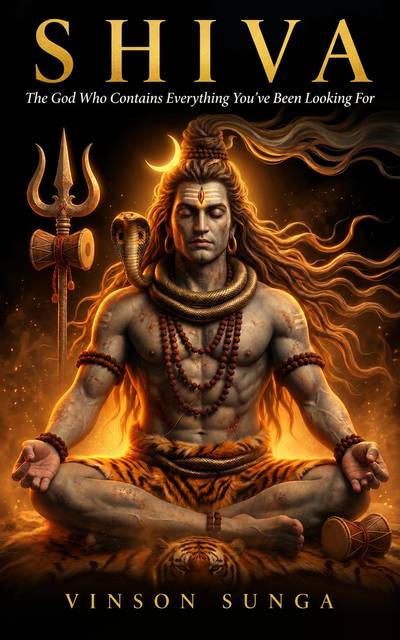
SHIVA
The God Who Contains Everything You've Been Looking For
4.7 on Amazon · 126 pages
Twelve chapters on the god who drank the world's poison — his wisdom, told through story, and how much of him you'll recognize in yourself.
No Sanskrit needed. No sermon. No background required.
Read it tonight. Returnable within 7 days.
Let me tell you about a god who does not behave like a god.
He lives at cremation grounds. He wears a live cobra as a necklace. A river pours from his matted hair.
He is also the most tender husband in all of mythology.
This book is for the ones who feel it — even when they can't name it.
Twelve chapters. Each one a door.
The last one tells you what to do with all of it.
The Howler
Before he was Shiva, he was the one who howled.
Written in His Body
Every object he wears means something. Here's what.
Fire and Snow
The love story that reframes what devotion means.
The Children Who Changed Everything
One born of cosmic fire. One fashioned from a mother's love.
The Blue Throat
The day he drank the poison every other god ran from.
Wild God
Desire burned to ash, a boy who held on as death pulled, and the day God ran from a demon.
The Dance Inside the Fire
Why a statue of Shiva stands at CERN, the world's largest physics laboratory.
Without Her He Is a Corpse
Take one vowel out of his name and it means corpse. This is why.
He Sat Still for So Long the Mountains Started Paying Attention
Every yoga class you've ever seen traces back to a god who sat still on a mountain.
Every Path Led to the Same God
Holy madmen, Kashmir philosophers, Tamil poet-saints and a 12th-century revolutionary.
The Places on Earth Where the Veil Gets Thin
A city where the fires never go out, twelve pillars of light, and a flame no one has explained.
How to Actually Meet Him
Not theory. What to do, if you want to begin.
Plus two appendices: A Brief Guide to Worship and Practice and The Faces of the Rudraksha Bead.
And an afterword: what 170 days of daily practice actually changed.
Most of its stories come from the Shiva Purana, retold for readers meeting him for the first time.
“Among all the treasures that came up from the cosmic ocean, Shiva took the simplest, most fragile one: the waning moon.”
Buy the book
Instant delivery Checkout on Amazon
Short enough to finish this weekend. Dense enough to return to for years.
Instant · read on any phone
Don't love it? Kindle books can be returned within 7 days of purchase.
This book is for you if
You've felt something sacred in silence — and never knew what to call it
You're drawn to mythology, yoga, or Eastern philosophy — but want the real depth
You've been asking a question you can't quite put into words
You don't consider yourself religious — but you've always felt something
You already love Shiva — and are ready to go deeper
No background in Hinduism needed. Only openness.
What readers say
“I was captivated by it all.” — Vero, Kindle reader
"One of the most beautiful love stories I've encountered in any book."
I didn't know much about Shiva before reading this. I finished it in two sittings. The chapter on Shiva and Parvati alone is worth the read.
Read on Amazon →"Fantastic read!"
I loved this book, learning about Shiva was something I never thought I would do but I was captivated by it all. It was thought provoking and one of those books that I will have to go back to. The story telling was beautiful and the author shows a sincerity in explaining Shiva and in his own path that keeps you engaged.
Read on Amazon →"Very interesting!!"
This was really enjoyable and different kind of read for me. The book talks the stories and meaning of Shiva in a simple, understandable way while sharing valuable life lessons. Whether you're interested in spirituality or just looking for a different perspective, this is definitely worth reading. Highly recommend!
Read on Amazon →A few quiet answers
Do I need to know anything about Hinduism?
Not at all. The book meets you exactly where you are.
How long will it take to read?
126 pages in paperback — a focused weekend read. About 3 hours as an audiobook.
Is this a religious book?
It's personal, not religious — written as a journey, not a sermon.
I was raised Christian. Is this book for me?
Vinson was too: raised in a Methodist church, and a youth leader in Australia. In his words: “What I found in Shiva did not contradict what I was raised to love. It completed it.”
Is this a scholarly book?
No. It's one seeker's journey through the stories, written for people meeting Shiva for the first time. If you want to go deeper, there's a reading list at the back.
I don't have a Kindle — can I still read it?
Yes. The free Kindle app works on any phone, tablet, or computer. Buy once, read anywhere — no device needed.
What if it's not for me?
Kindle books can be returned within 7 days of purchase. And Chapter 3 is free to read first, so you can see whether it speaks to you.
Who is this for?
Anyone drawn to mythology, yoga, or spirituality — or anyone who didn't expect to end up here and found themselves here anyway.
Can I feel it before I decide?
Yes — the whole of Chapter 3 is free to read or listen to, no email and no purchase needed. You can also read the first pages on Amazon's preview before you buy.
who wrote this
Born in Tagaytay, in the Philippines, and now living in Brisbane, Australia, Vinson Sunga spent years on a winding spiritual path before an unexpected series of events led him to Shiva. A lifelong musician and a practitioner of Kriya yoga, he has immersed himself in the mythology, philosophy, and living practice of one of the world's oldest spiritual traditions. He writes not as a scholar, but as someone who went looking for God — and found him.
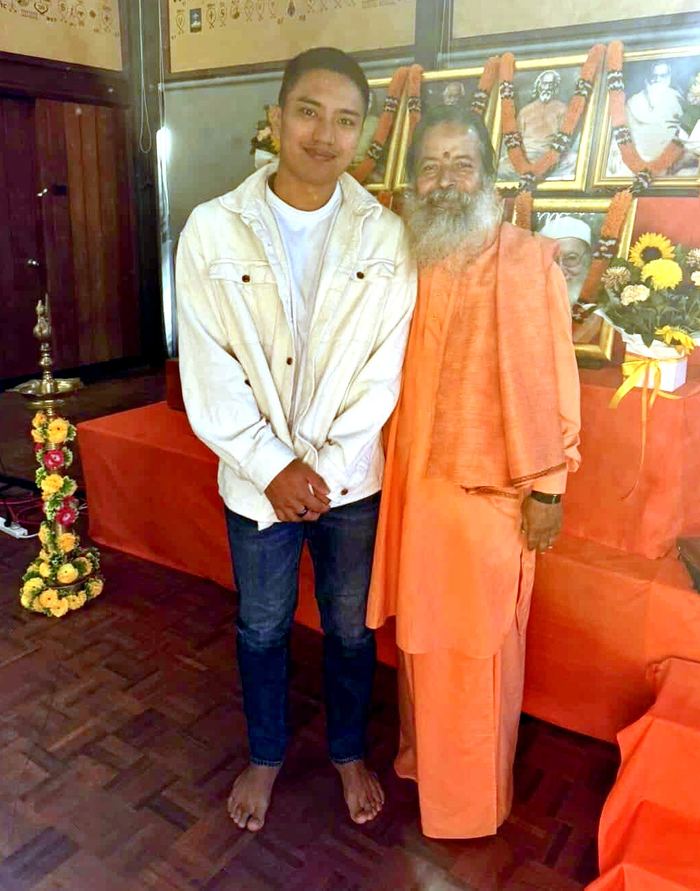
With Paramahansa Prajnanananda, a master of the Kriya yoga lineage
Press & media: vinsonpublishing@gmail.com
one last thing
You've read this far.
That's usually the sign.
Read it tonight. Returnable within 7 days.